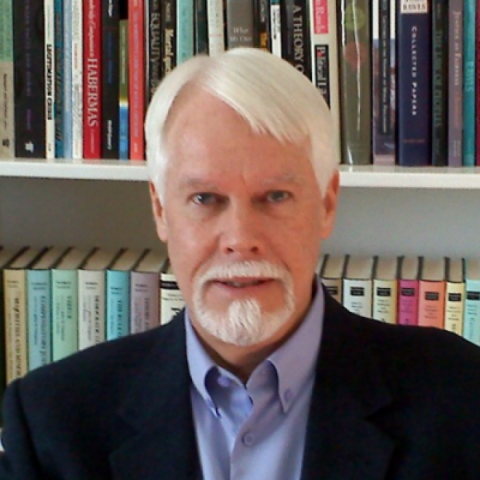
A. John Simmons
· John Allen Hollingsworth ProfessorUniversity of Virginia · Political and Social Thought
Active 1970–2020
About
A. John Simmons, also known as John Allen Hollingsworth, is a professor in the field of Political & Social Thought at the University of Virginia. His academic role involves engaging with the major requirements, course descriptions, and related scholarly activities within the department. The information provided indicates his position and contact details, but does not include specific details about his research focus, background, or key contributions.
Research signals
Five dimensions sourced from public faculty / publication signals. Sign in to compare against your own profile and see your match score.
Research topics
- Political Science
- Sociology
- Law and economics
- Environmental ethics
- Law
- Philosophy
- Epistemology
Selected publications
Moral Principles and Political Obligations
2020 · 8 citations
1st authorCorresponding- Political Science
- Sociology
- Political Science
Communications of the ACM · 2019-07-24 · 232 citations
articleOpen accessA Harvard-based pilot program integrates class sessions on ethical reasoning into courses throughout its computer science curriculum.
<i>Boundaries of Authority</i> : An introduction
Politics Philosophy & Economics · 2019-11-01
article1st authorCorrespondingThis is the Introduction to the symposium on A. John Simmons, Boundaries of Authority (Oxford: Oxford University Press, 2016). The Symposium contains articles by David Miller, Cara Nine, and Anna Stilz, and a response by the author.
2019-03-15
book-chapter1st authorCorrespondingThe problem of political obligation has been one of the central concerns of political philosophy throughout the history of the subject. Political obligations are the moral obligations of citizens to support and comply with the requirements of their political authorities; and the problem of political obligation is that of understanding why (or if) citizens in various kinds of states are bound by such obligations. Most theorists conservatively assume that typical citizens in reasonably just states are in fact bound by these obligations. They take the problem to be that of advancing an account of the ground(s) or justification(s) of political obligation that is consistent with affirming widespread obligations. Other theorists, however, anarchists prominent among them, do not accept the conservative assumption, leaving open the possibility that the best theory of political obligation may entail that few, if any, citizens in actual states have political obligations. Much of the modern debate about political obligation consists of attempts either to defend or to move beyond the alleged defects of voluntarist theories. Voluntarists maintain that only our own voluntary acts (such as freely consenting to the authority of our governments) can bind us to obedience. Because actual political societies appear not to be voluntary associations, however, voluntarism seems unable to satisfy conservative theoretical ambitions. Many theorists turn as a result to nonvoluntarist theories of political obligation, attempting to ground obligations in the receipt by citizens of the benefits governments supply, in the communal or associative obligations involved in citizens’ social and political roles or identities, or in the moral quality of their political institutions. Anarchists and other sceptics reject instead the conservative ambitions of such theories, defending positions that entail that all or most citizens even in just or decent states simply have no political obligations.
Descartes on the Causal Structure of Cognition
2019-07-23
book-chapter1st authorCorrespondingRené Descartes' treatment of the relationship between causation and cognition is shaped by his dualism, viz., his view that mind and body are distinct substances with fundamentally different natures, thought and extension. This chapter explores the causal structure of Cartesian cognition in general, noting some of the metaphysical puzzles to which it gives rise. Sensory cognition is an especially complex form of cognition that causally links world, human body, and human mind. The causal structure of human cognition involves the complex causal interplay of world, human bodies, and human minds. The human mind’s involuntary cognitions have their causal origin in some body, at least when God is not playing tricks on us and causing them himself. The chapter aims to discover the psycho-physical and psycho-physiological laws that govern sensory cognition. An explicit aim of Descartes’ account of sensory processing is to replace the Aristotelian species theory.
Rights and territories: A reply to Nine, Miller, and Stilz
Politics Philosophy & Economics · 2019-11-01 · 6 citations
article1st authorCorresponding‘Rights and Territories: A Reply to Nine, Miller, and Stilz’ defends the Lockean theory of states’ territorial rights (as this theory was presented in Boundaries of Authority) against the critiques of Nine, Miller, and Stilz. In response to Nine’s concern that such a Lockean theory cannot justify the right of legitimate states to exclude aliens, it is argued that a consent-based theory like the Lockean one is flexible enough to justify a wide range of possible incidents of territorial rights – importantly including, though not necessarily including, the sort of right to exclude aliens that is familiar from actual political practice. Miller’s criticisms are more wide-ranging. In response, the article argues that Lockean labor-based property rights are both stronger and more enduring than Miller suggests and that nationalism’s resources for dealing with concerns about rights-supersession and trapped minorities are importantly overstated by Miller. Against Stilz’s Kantian, ‘presentist’ account of states’ authority over persons and territories, it is argued that the rectification of past (historical) wrongs remains morally crucial even in the context of otherwise-just societies and that Stilz’s Kantian/Rawlsian position unconvincingly privileges the rights to autonomy of territorially concentrated groups over those of dissenting individuals or wrongfully dispersed groups.
2018-09-11
book-chapter1st authorCorrespondingThe problem of political obligation has been one of the central concerns of political philosophy throughout the history of the subject. Political obligations are the moral obligations of citizens to support and comply with the requirements of their political authorities; and the problem of political obligation is that of understanding why (or if) citizens in various kinds of states are bound by such obligations. Most theorists conservatively assume that typical citizens in reasonably just states are in fact bound by these obligations. They take the problem to be that of advancing an account of the ground(s) or justification(s) of political obligation that is consistent with affirming widespread obligations. Other theorists, however, anarchists prominent among them, do not accept the conservative assumption, leaving open the possibility that the best theory of political obligation may entail that few, if any, citizens in actual states have political obligations. Much of the modern debate about political obligation consists of attempts either to defend or to move beyond the alleged defects of voluntarist theories. Voluntarists maintain that only our own voluntary acts (such as freely consenting to the authority of our governments) can bind us to obedience. Because actual political societies appear not to be voluntary associations, however, voluntarism seems unable to satisfy conservative theoretical ambitions. Some individualists turn as a result to nonvoluntarist theories of political obligation, attempting to ground obligations in the receipt by citizens of the benefits governments supply or in the moral quality of their political institutions. Others reject individualism altogether, defending communitarian theories that base our political obligations in our social and political roles or identities. Individualist anarchists reject instead the conservative ambitions of such theories, embracing a voluntarism which entails that most citizens simply have no political obligations.
Embedded EthiCS: Integrating Ethics Broadly Across Computer Science Education
London School of Economics and Political Science Research Online (London School of Economics and Political Science) · 2018-08-16 · 13 citations
preprintOpen accessComputing technologies have become pervasive in daily life, sometimes bringing unintended but harmful consequences. For students to learn to think not only about what technology they could create, but also about what technology they should create, computer science curricula must expand to include ethical reasoning about the societal value and impact of these technologies. This paper presents Embedded EthiCS, a novel approach to integrating ethics into computer science education that incorporates ethical reasoning throughout courses in the standard computer science curriculum. It thus changes existing courses rather than requiring wholly new courses. The paper describes a pilot Embedded EthiCS program that embeds philosophers teaching ethical reasoning directly into computer science courses. It discusses lessons learned and challenges to implementing such a program across different types of academic institutions.
2018-09-11
book-chapter1st authorCorrespondingA concept of central importance in moral, political and legal philosophy, consent is widely recognized as justifying or legitimating acts, arrangements or expectations. In standard cases, a person’s consent to another person’s acts removes moral or legal objections to or liability for the performance of those acts. Thus, in medical practice the informed consent of a patient to a procedure can justify the physician’s actions. In law, the maxim ‘volenti non fit injuria’ (the willing person is not wronged) governs a wide range of acts and transactions, from the economic to the sexual. And in politics, it is often supposed that it is ‘the consent of the governed’ that justifies or makes permissible both governmental policies and the use of official coercion to compel obedience to law. Consent may be given in a variety of more and less direct forms, but its binding force always rests on the satisfaction of conditions of knowledge, intention, competence, voluntariness and acceptability of content.
Mind-Body Union and the Limits of Cartesian Metaphysics
The Journal of the Abraham Lincoln Association · 2017-07-21 · 39 citations
articleOpen access1st authorCorrespondingHuman beings pose a problem for Descartes’ metaphysics. They seem to be more than a mere sum of their mental and bodily parts; human beings, Descartes insists, are unions of mind and body. But what does that union amount to? In the first, negative, part of this paper I argue that, by Descartes’ own lights, there is no way for us to answer this question if we are looking for a proper metaphysics of the union. Metaphysics is the job of the intellect; it involves understanding. On Descartes’ considered view, we don’t understand the union; we feel it through the internal senses. In the second, positive, part of the paper I argue that, while Descartes does not (and cannot) give a properly metaphysical account of the union, he does provide a rich phenomenology of it that is of both theoretical and practical interest. Along the way, I suggest a phenomenological reading of a number of important passages that scholars have interpreted as Descartes’ attempt to provide a metaphysics of the union.
Frequent coauthors
- 4 shared
I. Colbeck
University of Essex
- 3 shared
James Longhurst
University of the West of England
- 2 shared
Gregory S. Kavka
- 2 shared
D.M. Elsom
Oxford Brookes University
- 2 shared
Barbara J. Grosz
- 2 shared
C.I. Beattie
- 2 shared
Jeff Behrends
Harvard University Press
- 2 shared
Lily Hu
Yale University
- Resume-aware match score
- Save to shortlist
- AI-drafted outreach
See your match with A. John Simmons
PhdFit ranks faculty by your research interests, methods, and publications — grounded in their actual work, not templates.
- Free to start
- No credit card
- 30-second signup