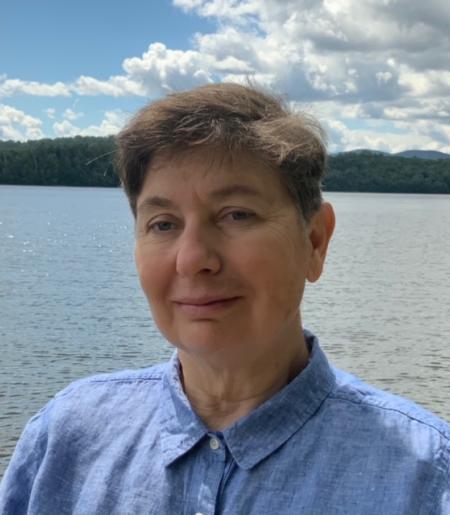
Mary Pat Brady
· Professor American Studies Program Latina/o Studies Program Literatures in EnglishCornell University · English
Active 1993–2025
About
Mary Pat Brady is a professor in the Department of Literatures in English at Cornell University. She is the author of the books 'Scales of Captivity: Racial Capitalism and the Latinx Child' and 'Extinct Lands, Temporal Geographies: Chicana Literature and the Urgency of Space,' both published by Duke University Press. Her work on 'Extinct Lands' was awarded the Modern Language Association’s Prize for the Best Work of Latina/o and Chicana/o Literary and Cultural Criticism. Brady has served as an associate editor of three editions of the Heath Anthology of American Literature, where she contributed to expanding the understanding of Latina/o authors' contributions to US literature. She also edited the ten-volume Gale Researcher: 20th and 21st Century American Literature Series (2017) and has authored numerous essays on Chicana literature, including the award-winning essay 'The Contrapuntal Geographies of Woman Hollering Creek and Other Stories.' Currently, she is the Director of the American Studies Program at Cornell University. Her research focuses on Chicana and Latine literature, film and culture, hemispheric literatures, critical geography, and children's literature. Brady is a proud, queer Chicana and is also a parent to three individuals.
Research topics
- Humanities
- Psychology
- Philosophy
- Theology
- Computer Science
- Art
- Biomedical engineering
- Epistemology
- Archaeology
- Psychoanalysis
- Engineering
- World Wide Web
- Art history
- Linguistics
- History
- Literature
Selected publications
Cambridge University Press eBooks · 2025-05-07
book-chapter1st authorCorrespondingUniversity of Arizona Press eBooks · 2023-10-10
book-chapter1st authorCorrespondingspecular morality, the war on drugs, and anxieties of visibility
University of Arizona Press eBooks · 2022-02-08
book-chapter1st authorCorrespondingCambridge University Press eBooks · 2021
1st authorCorresponding- History
- Art history
- Art
Mary Pat Brady’s chapter poses an alternative approach to hemispheric fiction by reading not according the scales of concentric geometries of space (local, regional, national, transnational), but instead reconceptualizing what she terms “pluriversal novels of the 21st century.” She argues for attending to the complexly mixed temporalities, perspectives, and languages of novels that reject the dualism of monoworlds (center/periphery) for the unpredictability of stories anchored in multiple space-times. While this is not an exclusively 21st-century phenomenon, she shows that pluriveral fiction has flourished recently, as works by Linda Hogan, Jennine Capó Crucet, Julia Alvarez, Gabby Rivera, Karen Tei Yamashita, Ana-Maurine Lara, and Evelina Zuni Lucero demonstrate.
Session One. A Question of Genealogies: Always Already (Chicana/o) Cultural Studies?
New York University Press eBooks · 2020-12-31
book-chapterNew York University Press eBooks · 2020-12-31
book-chapter1st authorCorrespondingSession Three. Staking the Claim: Introducing Applied Chicana/o Cultural Studies
New York University Press eBooks · 2020-12-31
book-chapterNew York University Press eBooks · 2020 · 1 citations
1st authorCorresponding- Humanities
- Art
- Humanities
Session Two. Chicana/o Cultural Studies: Marking Interdisciplinary Relationships and Conjunctures
New York University Press eBooks · 2020
- Computer Science
- Psychology
- Computer Science
Extinct Lands, Temporal Geographies
2020-11-20
book1st authorCorrespondingA train station becomes a police station; lands held sacred by Apaches and Mexicanos are turned into commercial and residential zones; freeway construction hollows out a community; a rancho becomes a retirement community-these are the kinds of spatial transformations that concern Mary Pat Brady in Extinct Lands, Temporal Geographies, a book bringing together Chicana feminism, cultural geography, and literary theory to analyze an unusual mix of Chicana texts through the concept of space. Beginning with nineteenth-century short stories and essays and concluding with contemporary fiction, this book reveals how Chicana literature offers a valuable theoretics of space.The history of the American Southwest in large part entails the transformation of lived, embodied space into zones of police surveillance, warehouse districts, highway interchanges, and shopping malls-a movement that Chicana writers have contested from its inception. Brady examines this long-standing engagement with space, first in the work of early newspaper essayists and fiction writers who opposed Anglo characterizations of Northern Sonora that were highly detrimental to Mexican Americans, and then in the work of authors who explore border crossing. Through the writing of Sandra Cisneros, Cherríe Moraga, Terri de la Peña, Norma Cantú, Monserrat Fontes, Gloria Anzaldúa, and others, Brady shows how categories such as race, gender, and sexuality are spatially enacted and created-and made to appear natural and unyielding. In a spatial critique of the war on drugs, she reveals how scale-the process by which space is divided, organized, and categorized-has become a crucial tool in the management and policing of the narcotics economy
Frequent coauthors
- 5 shared
Richard Yarborough
- 5 shared
James Kyung-Jin Lee
- 5 shared
Ivy Schweitzer
- 5 shared
John Alberti
Northern Kentucky University
- 5 shared
Quentin Miller
- 5 shared
Jackson R. Bryer
- 5 shared
Anne Goodwyn Jones
- 5 shared
Sandra A. Zagarell
Awards & honors
- Extinct Lands, Temporal Geographies: Chicana Literature and…
- Modern Language Association’s Prize for the Best Work of Lat…
- Norman Foerster Prize for the best essay published in Americ…
- Resume-aware match score
- Save to shortlist
- AI-drafted outreach
See your match with Mary Pat Brady
PhdFit ranks faculty by your research interests, methods, and publications — grounded in their actual work, not templates.
- Free to start
- No credit card
- 30-second signup