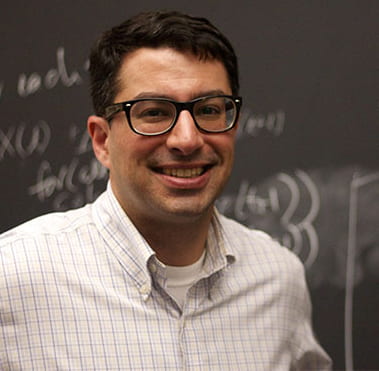
Aaron Dinner
· ProfessorVerifiedUniversity of Chicago · Immunology and Inflammation
Active 1994–2026
About
Aaron Dinner is a Professor of Chemistry at the University of Chicago, affiliated with the Committee on Immunology. His research focuses on tailoring interactions between active nematic defects using reinforcement learning, as well as exploring the mechanics and thermodynamics of growing vesicles. His work involves advanced computational methods, including pretrained graph neural networks with token mixers as geometric featurizers for conformational dynamics. Additionally, he investigates complex biochemical reaction dynamics, such as insulin dimer dissociation, and studies mechanisms related to circadian clock proteins like KaiB. His research also extends to biophysical processes, including calcium-activated contraction in giant cells and viral evolution in chronic infections, contributing to the understanding of biological systems through computational and experimental approaches.
Research signals
Five dimensions sourced from public faculty / publication signals. Sign in to compare against your own profile and see your match score.
Research topics
- Chemistry
- Machine Learning
- Cell biology
- Computer Science
- Genetics
- Artificial Intelligence
- Biology
- Computational chemistry
- Physics
- Biological system
- Mathematics
- Data science
- Biophysics
- Computational biology
- Nanotechnology
- Chemical physics
- Materials science
- Biochemistry
- Algorithm
- Computational science
- Optoelectronics
Selected publications
Composing diffusion priors with explicit physical context via generative Gibbs sampling
ArXiv.org · 2026-05-11
articleOpen accessSenior authorPretrained diffusion models provide powerful learned priors, but in scientific sampling the target distribution often depends on physical context that is not fully represented by one generative model. We introduce Generative Gibbs for Physics-Aware Sampling (GG-PA), a training-free framework that formulates the composition of learned partial priors and explicit physical context as inference over a joint target distribution in an augmented state space. We derive a Gibbs sampler for this joint target, show that it is asymptotically exact as the diffusion time approaches zero, and prove that in settings with quadratic interactions it remains exact at finite diffusion times. We further introduce replica exchange over diffusion time to accelerate mixing. Experiments on a double-well system, a $ϕ^4$ lattice model, and atomistic peptide systems show that GG-PA recovers context-induced distribution shifts and emergent collective behavior in interacting systems using partial priors without retraining. These results demonstrate GG-PA as a practical approach for combining pretrained generative priors with explicit physical context.
Quantum statistics from classical simulations via generative Gibbs sampling
Open MIND · 2026-01-28
preprintSenior authorAccurate simulation of nuclear quantum effects is essential for molecular modeling but expensive using path integral molecular dynamics (PIMD). We present GG-PI, a ring-polymer-based framework that combines generative modeling of the single-bead conditional density with Gibbs sampling to recover quantum statistics from classical simulation data. GG-PI uses inexpensive standard classical simulations or existing data for training and allows transfer across temperatures without retraining. On standard test systems, GG-PI significantly reduces wall clock time compared to PIMD. Our approach extends easily to a wide range of problems with similar Markov structure.
Tau-driven coordination of microtubule-actin crosstalk in cell-sized vesicles
Newton · 2026-03-01
articleOpen accessIn-context learning emerges in chemical reaction networks without attention
arXiv (Cornell University) · 2026-01-10
preprintOpen accessWe investigate whether chemical processes can perform in-context learning (ICL), a mode of computation typically associated with transformer architectures. ICL allows a system to infer task-specific rules from a sequence of examples without relying solely on fixed parameters. Traditional ICL relies on a pairwise attention mechanism which is not obviously implementable in chemical systems. However, we show theoretically and numerically that chemical processes can achieve ICL through a mechanism we call subspace projection, in which the entire input vector is mapped onto comparison subspaces, with the dominant projection determining the computational output. We illustrate this mechanism analytically in small chemical systems and show numerically that performance is robust to input encoding and dynamical choices, with the number of tunable degrees of freedom in the input encoding as a key limitation. Our results provide a blueprint for realizing ICL in chemical or other physical media and suggest new directions for designing adaptive synthetic chemical systems and understanding possible biological computation in cells.
Quantum statistics from classical simulations via generative Gibbs sampling
ArXiv.org · 2026-01-28
articleOpen accessSenior authorAccurate simulation of nuclear quantum effects is essential for molecular modeling but expensive using path integral molecular dynamics (PIMD). We present GG-PI, a ring-polymer-based framework that combines generative modeling of the single-bead conditional density with Gibbs sampling to recover quantum statistics from classical simulation data. GG-PI uses inexpensive standard classical simulations or existing data for training and allows transfer across temperatures without retraining. On standard test systems, GG-PI significantly reduces wall clock time compared to PIMD. Our approach extends easily to a wide range of problems with similar Markov structure.
In-context learning emerges in chemical reaction networks without attention
ArXiv.org · 2026-01-10
articleOpen accessWe investigate whether chemical processes can perform in-context learning (ICL), a mode of computation typically associated with transformer architectures. ICL allows a system to infer task-specific rules from a sequence of examples without relying solely on fixed parameters. Traditional ICL relies on a pairwise attention mechanism which is not obviously implementable in chemical systems. However, we show theoretically and numerically that chemical processes can achieve ICL through a mechanism we call subspace projection, in which the entire input vector is mapped onto comparison subspaces, with the dominant projection determining the computational output. We illustrate this mechanism analytically in small chemical systems and show numerically that performance is robust to input encoding and dynamical choices, with the number of tunable degrees of freedom in the input encoding as a key limitation. Our results provide a blueprint for realizing ICL in chemical or other physical media and suggest new directions for designing adaptive synthetic chemical systems and understanding possible biological computation in cells.
Light-induced assembly and repeatable actuation in Ca2+-driven chemomechanical protein networks
Nature Communications · 2026-02-21
articleOpen accessAbstract Programming rapid, repeatable motions in soft materials has remained a challenge in active matter and biomimetic design. Here, we present a light-controlled chemomechanical network based on Tetrahymena thermophila calcium-binding protein 2 (Tcb2), a Ca 2+ -sensitive contractile protein. These networks—driven by Ca 2+ -triggered structural rearrangements—exhibit dynamic self-assembly, spatiotemporal growth, and contraction rates comparable to actomyosin systems. By coupling light-sensitive chelators for optically triggered Ca 2+ release, we achieve precise growth and repeatable mechanical contractility of Tcb2 networks, revealing emergent phenomena such as boundary-localized active regions and density gradient-driven reversals in motion. A coupled reaction-diffusion and elastic model explains these dynamics, highlighting the interplay between chemical network assembly and mechanical response. We further demonstrate active transport of particles via network-mediated forces in vitro and implement reinforcement learning to program seconds-scale spatiotemporal actuation in silico. These results establish a platform for designing responsive active materials with rapid chemomechanical dynamics and tunable optical control, with applications in synthetic cells, sub-cellular force generation, and programmable biomaterials.
Adaptive tensor train metadynamics for high-dimensional free energy exploration
arXiv (Cornell University) · 2026-03-13
preprintOpen accessSenior authorA key challenge for molecular dynamics simulations is efficient exploration of free energy landscapes over relevant collective variables (CV). Common methods for enhancing sampling become prohibitively inefficient beyond only a few CVs; in the case of the widely-used metadynamics method, the computational cost of evaluating and storing the bias potential grows exponentially with the number of dimensions. Here, we introduce TT-Metadynamics, in which the accumulated sum of Gaussian functions in the original metadynamics method is periodically compressed into a low-rank tensor train (TT) representation. The TT enables efficient memory use and prevents the computational cost of evaluating the bias potential from increasing with simulation time. We present a "sketching" algorithm that allows us to construct the TT with linear scaling in the number of CVs. Applied to benchmark systems with up to 14 CVs, the accuracy of TT-Metadynamics matches or exceeds that of standard metadynamics in long simulations, particularly in systems with high barriers. These results establish TT-Metadynamics as a scalable and effective method for computing free energies that are functions of several CVs.
Adaptive tensor train metadynamics for high-dimensional free energy exploration
ArXiv.org · 2026-03-13
articleOpen accessSenior authorA key challenge for molecular dynamics simulations is efficient exploration of free energy landscapes over relevant collective variables (CV). Common methods for enhancing sampling become prohibitively inefficient beyond only a few CVs; in the case of the widely-used metadynamics method, the computational cost of evaluating and storing the bias potential grows exponentially with the number of dimensions. Here, we introduce TT-Metadynamics, in which the accumulated sum of Gaussian functions in the original metadynamics method is periodically compressed into a low-rank tensor train (TT) representation. The TT enables efficient memory use and prevents the computational cost of evaluating the bias potential from increasing with simulation time. We present a "sketching" algorithm that allows us to construct the TT with linear scaling in the number of CVs. Applied to benchmark systems with up to 14 CVs, the accuracy of TT-Metadynamics matches or exceeds that of standard metadynamics in long simulations, particularly in systems with high barriers. These results establish TT-Metadynamics as a scalable and effective method for computing free energies that are functions of several CVs.
Composing diffusion priors with explicit physical context via generative Gibbs sampling
arXiv (Cornell University) · 2026-05-11
preprintOpen accessSenior authorPretrained diffusion models provide powerful learned priors, but in scientific sampling the target distribution often depends on physical context that is not fully represented by one generative model. We introduce Generative Gibbs for Physics-Aware Sampling (GG-PA), a training-free framework that formulates the composition of learned partial priors and explicit physical context as inference over a joint target distribution in an augmented state space. We derive a Gibbs sampler for this joint target, show that it is asymptotically exact as the diffusion time approaches zero, and prove that in settings with quadratic interactions it remains exact at finite diffusion times. We further introduce replica exchange over diffusion time to accelerate mixing. Experiments on a double-well system, a $ϕ^4$ lattice model, and atomistic peptide systems show that GG-PA recovers context-induced distribution shifts and emergent collective behavior in interacting systems using partial priors without retraining. These results demonstrate GG-PA as a practical approach for combining pretrained generative priors with explicit physical context.
Recent grants
NSF · $506k · 2020–2024
NIH · $2.2M · 2020–2031
NIH · $1.4M · 2020
A systems-level study of signaling networks and differentiation
NIH · $1.5M · 2016–2020
Collaborative Research: Mechanics of Reconstituted Self-Organized Contractile Actomyosin Systems
NSF · $533k · 2022–2026
Frequent coauthors
- 105 shared
Jonathan Weare
- 51 shared
Erik H. Thiede
Cornell University
- 47 shared
Martin Karplus
Harvard University
- 43 shared
Chatipat Lorpaiboon
University of Chicago
- 33 shared
Norbert F. Scherer
University of Chicago
- 33 shared
Robert J. Webber
California Institute of Technology
- 32 shared
Aryeh Warmflash
Rice University
- 27 shared
Alan L. Hutchison
Labs
- Resume-aware match score
- Save to shortlist
- AI-drafted outreach
See your match with Aaron Dinner
PhdFit ranks faculty by your research interests, methods, and publications — grounded in their actual work, not templates.
- Free to start
- No credit card
- 30-second signup