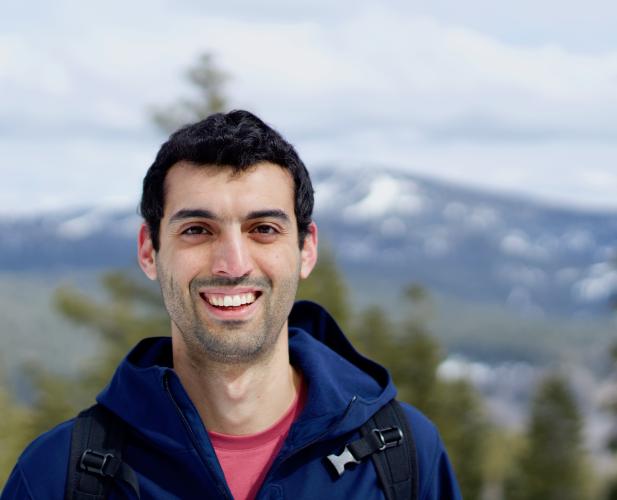
Ahmed El Alaoui
· Assistant Professor of Statistics and Data ScienceVerifiedCornell University · Computer Science
Active 1989–2026
About
Ahmed El Alaoui is an assistant professor of statistics and data science at Cornell University. His research interests revolve around high-dimensional phenomena in statistics and probability theory, statistical physics, algorithms, and problems where these areas meet. Prior to joining the Cornell faculty in 2021, he was a postdoctoral researcher at Stanford University, hosted by Andrea Montanari. He received his Ph.D. in electrical engineering and computer sciences from UC Berkeley in 2018, advised by Michael I. Jordan.
Research signals
Five dimensions sourced from public faculty / publication signals. Sign in to compare against your own profile and see your match score.
Research topics
- Physics
- Combinatorics
- Nuclear physics
- Atomic physics
- Mathematics
- Particle physics
- Quantum mechanics
- Geometry
- Mathematical physics
Selected publications
Computers & Electrical Engineering · 2026-03-28
articleInternational Journal of Communication Networks and Distributed Systems · 2026-01-01
articleSenior authorIn cognitive radio networks (CRNs), cooperative spectrum sensing (CSS) improves spectrum sensing performance in radio environments subject to fading and shadowing. However, when some secondary users (SUs) share falsified sensing information in CSS through a falsification attack on sensing data (spectrum sensing data falsification attack, SSDF), the sensing performance degrades significantly. This document proposes a new probabilistic SSDF attack model and a new defence strategy based on a robust identification and suppression mechanism against massive SSDF attacks. Simulation results obtained under various massive probabilistic SSDF attack scenarios show that the detection performance of the proposed defence scheme outperforms that of the weighted sequential probability ratio test (WSPRT), sequential probability ratio test (SPRT), and Majority fusion techniques with which comparisons have been made. The proposed defence scheme guarantees a near-zero probability of error whatever the number of attackers and whatever the SSDF attack strategy, which is not the case for WSPRT, SPRT, and Majority rule.
Sampling from mean-field Gibbs measures via diffusion processes
Probability and Mathematical Physics · 2025-07-21 · 1 citations
articleOpen access1st authorCorrespondingPhysical review. C · 2025-11-12
preprintOpen accessMeasurements of beam single-spin asymmetries in semi-inclusive deep-inelastic electron scattering (SIDIS) with positively charged kaons off protons have been performed with 10.6 and 10.2 GeV incident electron beams using the CLAS12 spectrometer at Jefferson Lab. We report an analysis of the electroproduction of positively charged kaons over a large kinematic range of fractional energy, Bjorken <a:math xmlns:a="http://www.w3.org/1998/Math/MathML"> <a:mi>x</a:mi> </a:math> , transverse momentum, and photon virtualities <b:math xmlns:b="http://www.w3.org/1998/Math/MathML"> <b:msup> <b:mi>Q</b:mi> <b:mn>2</b:mn> </b:msup> </b:math> ranging from 1 <c:math xmlns:c="http://www.w3.org/1998/Math/MathML"> <c:msup> <c:mrow> <c:mi>GeV</c:mi> </c:mrow> <c:mn>2</c:mn> </c:msup> </c:math> up to 6 <d:math xmlns:d="http://www.w3.org/1998/Math/MathML"> <d:msup> <d:mrow> <d:mi>GeV</d:mi> </d:mrow> <d:mn>2</d:mn> </d:msup> </d:math> . This is the first published multidimensionally binned CLAS12 measurement of a kaon SIDIS single-spin asymmetry in the valence quark regime. The data provide constraints on the structure function ratio <e:math xmlns:e="http://www.w3.org/1998/Math/MathML"> <e:mrow> <e:msubsup> <e:mi>F</e:mi> <e:mrow> <e:mi>L</e:mi> <e:mi>U</e:mi> </e:mrow> <e:mrow> <e:mo form="prefix">sin</e:mo> <e:mi>ϕ</e:mi> </e:mrow> </e:msubsup> <e:mo>/</e:mo> <e:msub> <e:mi>F</e:mi> <e:mrow> <e:mi>U</e:mi> <e:mi>U</e:mi> </e:mrow> </e:msub> </e:mrow> </e:math> , where <g:math xmlns:g="http://www.w3.org/1998/Math/MathML"> <g:msubsup> <g:mi>F</g:mi> <g:mrow> <g:mi>L</g:mi> <g:mi>U</g:mi> </g:mrow> <g:mrow> <g:mo form="prefix">sin</g:mo> <g:mi>ϕ</g:mi> </g:mrow> </g:msubsup> </g:math> is a quantity with a leading twist of twist-3 that can reveal novel aspects of the quark-gluon correlations within the nucleon. The impact of the data on understanding the underlying reaction mechanisms and their kinematic variation is explored using theoretical models for the different contributing twist-3 parton-distribution functions (PDFs) and fragmentation functions (FFs).
Comprehensive dataset for olive tree varieties responses to different level of drought stress
Data in Brief · 2025-09-01
articleOpen accessSenior authorThis study presents a detailed dataset on the growth responses of 80 young olive trees from three varieties: Haouzia and Menara (Moroccan) and Languedoc (French), under varying levels of water stress. The experiment was organised into eight groups: four experimental (A1, B1, C1, D1) and four control (A2, B2, C2, D2), with each group comprising 10 olive trees (4 Languedoc, 3 Menara, and 3 Haouzia). The olive trees were subjected to four distinct irrigation regimes, with groups A1 and A2 receiving 100 % of the water requirement, groups B1 and B2 receiving 50 %, groups C1 and C2 receiving 25 %, and groups D1 and D2 receiving no irrigation (0 %). Weekly data collection included trunk diameter, tree height, number of branches, SPAD values, leaf temperature, canopy cover, and individual tree images. This dataset offers valuable information for prospective researchers working on the impacts of drought stress on different varieties of olive trees, facilitating comparative analysis at varying stress levels. It is also useful for farmers, providing insights that can help optimize irrigation strategies and improve drought resilience in olive tree cultivation. The dataset can also be used to develop predictive artificial intelligence models for monitoring and analyzing drought stress in olive trees.
World Water Policy · 2025-01-22 · 3 citations
articleSenior authorABSTRACT Climate data are essential for agricultural planning and water resource management; however, their availability is limited in numerous regions of Africa. Gridded climate data present a potential solution, yet, their accuracy in estimating reference evapotranspiration (ET o ) remains uncertain. This study aims to evaluate the performance of gridded climate data in comparison to ground‐based observations for predicting ET o in the Fes region of Morocco. Two machine learning (ML) models, random forest (RF) and long short‐term memory (LSTM), were trained and tested on 10 years of data from both gridded (AgERA5) and ground (in situ) observation sources to assess their predictive capabilities. The results demonstrated that RF outperformed LSTM under fewer input parameter configurations, achieving R 2 > 0.70, while LSTM exhibited superior performance across all input configurations achieving R 2 > 0.95. However, AgERA5 data consistently underestimated ET o compared to ground observations. This underestimation highlights the need for bias correction to improve gridded data reliability. Addressing these limitations would allow gridded datasets to support better irrigation scheduling, enhance water use efficiency, and reduce crop stress in regions with limited access to localized climate data. This study demonstrates the potential of combining gridded climate data with ML to bridge data gaps, while emphasizing the importance of improving gridded dataset accuracy for practical applications in water management.
Hardness of Sampling Solutions From the Symmetric Binary Perceptron
Random Structures and Algorithms · 2025-07-01 · 2 citations
articleOpen access1st authorCorrespondingABSTRACT We show that two related classes of algorithms, stable algorithms and Boolean circuits with bounded depth, cannot produce an approximate sample from the uniform measure over the set of solutions to the symmetric binary perceptron model at any constraint‐to‐variable density. This result is in contrast to the question of finding a solution to the same problem, where efficient (and stable) algorithms are known to succeed at sufficiently low density. This result suggests that the solutions found efficiently—whenever this task is possible—must be highly atypical, and therefore provides an example of a problem where search is efficiently possible but approximate sampling from the set of solutions is not, at least within these two classes of algorithms.
Shattering in Pure Spherical Spin Glasses
Communications in Mathematical Physics · 2025-04-12 · 5 citations
article1st authorCorrespondingDevelopment of an Expert System for Precision Irrigation: Knowledge Modeling Approach
IEEE Access · 2025-01-01 · 1 citations
articleOpen accessSenior authorPrecision irrigation necessitates decision support systems that are both efficient and comprehensible to farmers and agronomists. Numerous current solutions depend on Internet of Things (IoT) frameworks or black-box artificial intelligence (AI) models, which frequently encounter challenges related to interoperability, transparency, and reproducibility. To overcome these constraints, this research developed an ontology-driven expert system that formalizes knowledge of crops, soil, and climate into a modular framework capable of generating explicable irrigation recommendations. The system was developed using the Web Ontology Language (OWL) and augmented with Semantic Web Rule Language (SWRL) rules, employing a hybrid development methodology that integrates the structured precision of the V-cycle with the data-driven focus of the Cross-Industry Standard Process for Data Mining (CRISP-DM) and the semantic precision of the NeOn (Networked Ontologies) methodology. Competency questions guided the development of numerous agricultural concepts pertaining to irrigation. Scenario-based assessments validated that the ontology accurately deduced crop coefficient (Kc), integrated AI-predicted ET0 with sensor-derived assertions, and produced consistent irrigation or non-irrigation recommendations across diverse situations. All reasoning processes performed in under one second, showcasing computational efficiency. Thus, the research provides a replicable and adaptable foundation for ontology-based irrigation decision support, facilitating future implementation using real-time sensor data and field validation.
Measurement of Beam-Recoil Observables $C_x$ and $C_z$ for $K^+Λ$ Photoproduction
ArXiv.org · 2025-08-13
preprintOpen accessExclusive photoproduction of $K^+ Λ$ final states off a proton target has been an important component in the search for missing nucleon resonances and our understanding of the production of final states containing strange quarks. Polarization observables have been instrumental in this effort. The current work is an extension of previously published CLAS results on the beam-recoil transferred polarization observables $C_x$ and $C_z$. We extend the kinematic range up to invariant mass $W=3.33$~GeV from the previous limit of $W=2.5$~GeV with significantly improved statistical precision in the region of overlap. These data will provide for tighter constraints on the reaction models used to unravel the spectrum of nucleon resonances and their properties by not only improving the statistical precision of the data within the resonance region, but also by constraining $t$-channel processes that dominate at higher $W$ but extend into the resonance region.
Frequent coauthors
- 343 shared
E. Voutier
Université Paris-Saclay
- 306 shared
F. Sabatié
CEA Paris-Saclay
- 263 shared
S. Niccolai
Université Paris-Saclay
- 238 shared
C. Muñoz Camacho
Université Paris-Saclay
- 231 shared
R. Dupré
Laboratoire de Physique des 2 Infinis Irène Joliot-Curie
- 230 shared
M. Guidal
Université Paris-Saclay
- 223 shared
A. D’Angelo
- 189 shared
H. Hakobyan
University of California, Riverside
Labs
Education
- 2018
Ph.D., electrical engineering and computer sciences
UC Berkeley
- Resume-aware match score
- Save to shortlist
- AI-drafted outreach
See your match with Ahmed El Alaoui
PhdFit ranks faculty by your research interests, methods, and publications — grounded in their actual work, not templates.
- Free to start
- No credit card
- 30-second signup