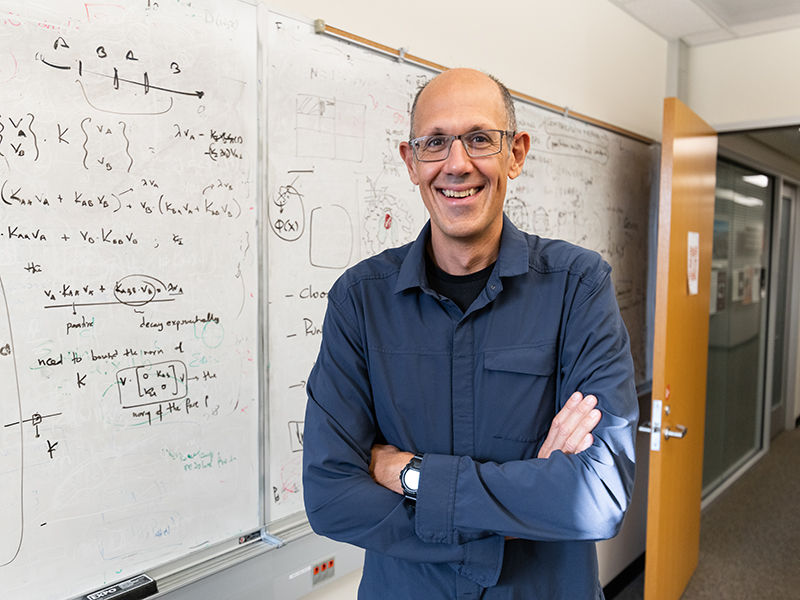
George Biros
· ProfessorVerifiedUniversity of Texas at Austin · Mechanical Engineering
Active 1999–2026
About
George Biros is a professor holding the W.A. "Tex" Moncrief, Jr. Endowment in Simulation-based Engineering Sciences Endowed Chair No. 2 at the University of Texas at Austin. He earned his Ph.D. in Computational Science and Engineering from Carnegie Mellon University and held a post-doctoral appointment at NYU's Courant Institute of Mathematical Sciences. He has also held faculty positions at the University of Pennsylvania and Georgia Institute of Technology. His research group focuses on computational mathematics and the invention of new parallel algorithms for physics-based simulations and large-scale data analysis. His work aims to develop technologies for discovery and innovation that will harness upcoming breakthroughs in high performance computing, including exascale platforms. Current research topics include parallel algorithms, numerical algorithms for integral and differential equations, inverse problems, data assimilation, computational statistics, biological complex fluids, blood rheology, soft tissue and cardiovascular mechanics, and medical image analysis. George Biros's contributions have been recognized through awards such as the Association for Computing Machinery's Gordon Bell Prize and the Early Career Young Investigator Award from the U.S. Department of Energy. He is also an associate editor of the Society for Industrial and Applied Mathematics Journal on Scientific Computing.
Research topics
- Artificial Intelligence
- Computer Science
- Medicine
- Medical physics
- Mathematics
- Computer vision
- Parallel computing
- Risk analysis (engineering)
- Algorithm
- Biology
- Computational science
- Pathology
- Management science
- Neuroscience
- Radiology
- Computer graphics (images)
- Mathematical optimization
Selected publications
HERMES: A fast transient heat transfer solver for metal additive manufacturing
Computer Methods in Applied Mechanics and Engineering · 2026-01-06
articleSenior authorCorrespondingLatent-IMH: Efficient Bayesian Inference for Inverse Problems with Approximate Operators
Open MIND · 2026-01-28
preprintSenior authorWe study sampling from posterior distributions in Bayesian linear inverse problems where $A$, the parameters to observables operator, is computationally expensive. In many applications, $A$ can be factored in a manner that facilitates the construction of a cost-effective approximation $\tilde{A}$. In this framework, we introduce Latent-IMH, a sampling method based on the Metropolis-Hastings independence (IMH) sampler. Latent-IMH first generates intermediate latent variables using the approximate $\tilde{A}$, and then refines them using the exact $A$. Its primary benefit is that it shifts the computational cost to an offline phase. We theoretically analyze the performance of Latent-IMH using KL divergence and mixing time bounds. Using numerical experiments on several model problems, we show that, under reasonable assumptions, it outperforms state-of-the-art methods such as the No-U-Turn sampler (NUTS) in computational efficiency. In some cases, Latent-IMH can be orders of magnitude faster than existing schemes.
Inverse problems for history-enriched linear model reduction
arXiv (Cornell University) · 2026-01-11
preprintOpen accessSenior authorStandard projection-based model reduction for dynamical systems incurs closure error because it only accounts for instantaneous dependence on the resolved state. From the Mori-Zwanzig (MZ) perspective, projecting the full dynamics onto a low-dimensional resolved subspace induces additional noise and memory terms arising from the dynamics of the unresolved component in the orthogonal complement. The memory term makes the resolved dynamics explicitly history dependent. In this work, based on the MZ identity, we derive exact, history-enriched models for the resolved dynamics of linear driven dynamical systems and formulate inverse problems to learn model operators from discrete snapshot data via least-squares regression. We propose a greedy time-marching scheme to solve the inverse problems efficiently and analyze operator identifiability under full and partial observation data availability. For full observation data, we show that, under mild assumptions, the operators are identifiable even when the full-state dynamics are governed by a general time-varying linear operator, whereas with partial observation data the inverse problem has a unique solution only when the full-state operator is time-invariant. To address the resulting non-uniqueness in the time-varying case, we introduce a time-smoothing Tikhonov regularization. Numerical results demonstrate that the operators can be faithfully reconstructed from both full and partial observation data and that the learned history-enriched MZ models yield accurate trajectories of the resolved state.
Open MIND · 2026-02-24
preprintSenior authorWe consider the problem of sampling from a posterior distribution arising in Bayesian inverse problems in science, engineering, and imaging. Our method belongs to the family of independence Metropolis-Hastings (IMH) sampling algorithms, which are common in Bayesian inference. Relying on the existence of an approximate posterior distribution that is cheaper to sample from but may have significant bias, we introduce Proximal-IMH, a scheme that removes this bias by correcting samples from the approximate posterior through an auxiliary optimization problem. This yields a local adjustment that trades off adherence to the exact model against stability around the approximate reference point. For idealized settings, we prove that the proximal correction tightens the match between approximate and exact posteriors, thereby improving acceptance rates and mixing. The method applies to both linear and nonlinear input-output operators and is particularly suitable for inverse problems where exact posterior sampling is too expensive. We present numerical experiments including multimodal and data-driven priors with nonlinear input-output operators. The results show that Proximal-IMH reliably outperforms existing IMH variants.
LNODE: latent dynamics reveal the shared spatiotemporal structure of amyloid-$β$ progression
arXiv (Cornell University) · 2026-04-30
articleOpen accessSenior authorWe introduce LNODE, a mechanism-based phenomenological model for amyloid beta (A$β$) dynamics, calibrated using positron emission tomography (PET) imaging. A$β$ is a key biomarker of Alzheimer's disease. LNODE is designed to support the fusion, harmonization, quantitative analysis, and interpretation of Abeta PET scans. We evaluate LNODE on 1461 subjects in the ADNI cohort and 1070 subjects in the A4 Study, using MUSE and DKT anatomical atlases. LNODE is formulated as a regional neural ordinary differential equation (ODE) model that is jointly calibrated on all available scans within a cohort. The model captures the spatial propagation, proliferation, and clearance of A$β$ and incorporates a latent-state representation that modulates A$β$ dynamics. The temporal evolution of these latent states is governed by cohort-shared parameters, enabling LNODE to represent both population-level trajectories and subject-specific deviations. The proposed model demonstrates strong parameter identifiability and stability properties, supported by synthetic experiments and analytical analysis of the Hessian condition number. To mitigate overfitting and reduce spurious correlations, LNODE is intentionally underparameterized, employing approximately five to ten parameters per subject. Despite this parsimonious parameterization, LNODE achieves $R^2 > 0.99$ in both the ADNI and A4 datasets. LNODE exhibits strong predictive performance: in the A4 cohort, it accurately forecasts the A$β$ PET signal in previously unseen follow-up scans, including cases with inter-scan intervals exceeding four years. Clustering in the learned latent-state space reveals distinct subgroups, consistent with the existence of different subtypes of Alzheimer's disease progression.
Inverse problems for history-enriched linear model reduction
ArXiv.org · 2026-01-11
articleOpen accessSenior authorStandard projection-based model reduction for dynamical systems incurs closure error because it only accounts for instantaneous dependence on the resolved state. From the Mori-Zwanzig (MZ) perspective, projecting the full dynamics onto a low-dimensional resolved subspace induces additional noise and memory terms arising from the dynamics of the unresolved component in the orthogonal complement. The memory term makes the resolved dynamics explicitly history dependent. In this work, based on the MZ identity, we derive exact, history-enriched models for the resolved dynamics of linear driven dynamical systems and formulate inverse problems to learn model operators from discrete snapshot data via least-squares regression. We propose a greedy time-marching scheme to solve the inverse problems efficiently and analyze operator identifiability under full and partial observation data availability. For full observation data, we show that, under mild assumptions, the operators are identifiable even when the full-state dynamics are governed by a general time-varying linear operator, whereas with partial observation data the inverse problem has a unique solution only when the full-state operator is time-invariant. To address the resulting non-uniqueness in the time-varying case, we introduce a time-smoothing Tikhonov regularization. Numerical results demonstrate that the operators can be faithfully reconstructed from both full and partial observation data and that the learned history-enriched MZ models yield accurate trajectories of the resolved state.
Latent-IMH: Efficient Bayesian Inference for Inverse Problems with Approximate Operators
ArXiv.org · 2026-01-28
articleOpen accessSenior authorWe study sampling from posterior distributions in Bayesian linear inverse problems where $A$, the parameters to observables operator, is computationally expensive. In many applications, $A$ can be factored in a manner that facilitates the construction of a cost-effective approximation $\tilde{A}$. In this framework, we introduce Latent-IMH, a sampling method based on the Metropolis-Hastings independence (IMH) sampler. Latent-IMH first generates intermediate latent variables using the approximate $\tilde{A}$, and then refines them using the exact $A$. Its primary benefit is that it shifts the computational cost to an offline phase. We theoretically analyze the performance of Latent-IMH using KL divergence and mixing time bounds. Using numerical experiments on several model problems, we show that, under reasonable assumptions, it outperforms state-of-the-art methods such as the No-U-Turn sampler (NUTS) in computational efficiency. In some cases, Latent-IMH can be orders of magnitude faster than existing schemes.
LNODE: latent dynamics reveal the shared spatiotemporal structure of amyloid-$β$ progression
PubMed Central · 2026-04-30
preprintOpen accessSenior authorWe introduce LNODE, a mechanism-based phenomenological model for amyloid beta (A$β$) dynamics, calibrated using positron emission tomography (PET) imaging. A$β$ is a key biomarker of Alzheimer's disease. LNODE is designed to support the fusion, harmonization, quantitative analysis, and interpretation of Abeta PET scans. We evaluate LNODE on 1461 subjects in the ADNI cohort and 1070 subjects in the A4 Study, using MUSE and DKT anatomical atlases. LNODE is formulated as a regional neural ordinary differential equation (ODE) model that is jointly calibrated on all available scans within a cohort. The model captures the spatial propagation, proliferation, and clearance of A$β$ and incorporates a latent-state representation that modulates A$β$ dynamics. The temporal evolution of these latent states is governed by cohort-shared parameters, enabling LNODE to represent both population-level trajectories and subject-specific deviations. The proposed model demonstrates strong parameter identifiability and stability properties, supported by synthetic experiments and analytical analysis of the Hessian condition number. To mitigate overfitting and reduce spurious correlations, LNODE is intentionally underparameterized, employing approximately five to ten parameters per subject. Despite this parsimonious parameterization, LNODE achieves $R^2 > 0.99$ in both the ADNI and A4 datasets. LNODE exhibits strong predictive performance: in the A4 cohort, it accurately forecasts the A$β$ PET signal in previously unseen follow-up scans, including cases with inter-scan intervals exceeding four years. Clustering in the learned latent-state space reveals distinct subgroups, consistent with the existence of different subtypes of Alzheimer's disease progression.
ArXiv.org · 2026-02-24
articleOpen accessSenior authorWe consider the problem of sampling from a posterior distribution arising in Bayesian inverse problems in science, engineering, and imaging. Our method belongs to the family of independence Metropolis-Hastings (IMH) sampling algorithms, which are common in Bayesian inference. Relying on the existence of an approximate posterior distribution that is cheaper to sample from but may have significant bias, we introduce Proximal-IMH, a scheme that removes this bias by correcting samples from the approximate posterior through an auxiliary optimization problem. This yields a local adjustment that trades off adherence to the exact model against stability around the approximate reference point. For idealized settings, we prove that the proximal correction tightens the match between approximate and exact posteriors, thereby improving acceptance rates and mixing. The method applies to both linear and nonlinear input-output operators and is particularly suitable for inverse problems where exact posterior sampling is too expensive. We present numerical experiments including multimodal and data-driven priors with nonlinear input-output operators. The results show that Proximal-IMH reliably outperforms existing IMH variants.
LNODE: latent dynamics reveal the shared spatiotemporal structure of amyloid-$β$ progression.
PubMed · 2026-04-30
articleSenior authorWe introduce LNODE, a mechanism-based phenomenological model for amyloid beta (A$β$) dynamics, calibrated using positron emission tomography (PET) imaging. A$β$ is a key biomarker of Alzheimer's disease. LNODE is designed to support the fusion, harmonization, quantitative analysis, and interpretation of Abeta PET scans. We evaluate LNODE on 1461 subjects in the ADNI cohort and 1070 subjects in the A4 Study, using MUSE and DKT anatomical atlases. LNODE is formulated as a regional neural ordinary differential equation (ODE) model that is jointly calibrated on all available scans within a cohort. The model captures the spatial propagation, proliferation, and clearance of A$β$ and incorporates a latent-state representation that modulates A$β$ dynamics. The temporal evolution of these latent states is governed by cohort-shared parameters, enabling LNODE to represent both population-level trajectories and subject-specific deviations. The proposed model demonstrates strong parameter identifiability and stability properties, supported by synthetic experiments and analytical analysis of the Hessian condition number. To mitigate overfitting and reduce spurious correlations, LNODE is intentionally underparameterized, employing approximately five to ten parameters per subject. Despite this parsimonious parameterization, LNODE achieves $R^2 > 0.99$ in both the ADNI and A4 datasets. LNODE exhibits strong predictive performance: in the A4 cohort, it accurately forecasts the A$β$ PET signal in previously unseen follow-up scans, including cases with inter-scan intervals exceeding four years. Clustering in the learned latent-state space reveals distinct subgroups, consistent with the existence of different subtypes of Alzheimer's disease progression.
Recent grants
SHF: Small: Algorithms and Software for Scalable Kernel Methods
NSF · $486k · 2018–2021
NSF · $329k · 2004–2009
Collaborative Research: Petascale Algorithms for Particulate Flows
NSF · $438k · 2007–2009
NSF · $250k · 2012–2013
CDS&E: AI-RHEO: Learning coarse-graining of complex fluids
NSF · $405k · 2022–2026
Frequent coauthors
- 37 shared
Christos Davatzikos
University of Pennsylvania
- 30 shared
Denis Zorin
New York University
- 22 shared
Andreas Mang
University of Houston
- 21 shared
Hari Sundar
Madras Medical Mission
- 21 shared
Shashank Subramanian
National Energy Research Scientific Computing Center
- 20 shared
Omar Ghattas
The University of Texas at Austin
- 19 shared
Chenhan D. Yu
Yuan Ze University
- 18 shared
Bryan Quaife
Florida State University
Labs
Education
Ph.D., Computational Science and Engineering
Carnegie Mellon University
Other
New York University's Courant Institute of Mathematical Sciences
Awards & honors
- Association for Computing Machinery's Gordon Bell Prize
- Early Career Young Investigator Award from the U.S. Departme…
- Resume-aware match score
- Save to shortlist
- AI-drafted outreach
See your match with George Biros
PhdFit ranks faculty by your research interests, methods, and publications — grounded in their actual work, not templates.
- Free to start
- No credit card
- 30-second signup