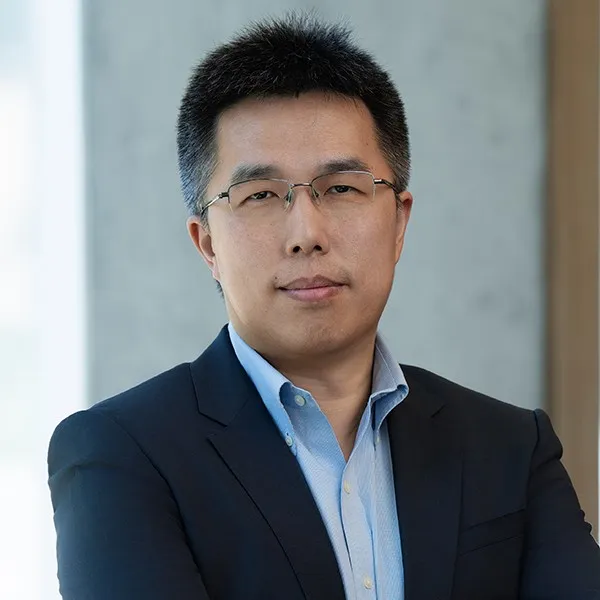
Liang Jiang
· Professor of Molecular Engineering in the UChicago Pritzker School of Molecular EngineeringVerifiedUniversity of Chicago · Departments of Physics and Molecular Genetics and Cell Biology
Active 1981–2026
About
Liang Jiang is a Professor of Molecular Engineering at the University of Chicago Pritzker School of Molecular Engineering. His research theoretically investigates quantum systems and explores various quantum applications, including quantum sensing, quantum transduction, quantum communication, and quantum computation. His focus is on using quantum control and error correction to protect quantum information from decoherence, aiming to realize robust quantum information processing. Jiang has worked on modular quantum computation, global-scale quantum networks, room-temperature nano-magnetometers, sub-wavelength imaging, micro-optical quantum transduction, and error-correction-assisted quantum sensing and simulation. He received his BS from Caltech in 2004 and his PhD from Harvard University in 2009. Following his doctoral studies, he worked as a Sherman Fairchild postdoctoral fellow at Caltech. In 2012, Jiang joined Yale University as an assistant professor and later as an associate professor of Applied Physics. He was awarded the Alfred P. Sloan Research Fellowship and the David and Lucile Packard Foundation Fellowship in 2013. In 2019, he moved to his current position at the University of Chicago. His group investigates quantum control and quantum error correction across various physical platforms, with potential applications in quantum sensing, transduction, communication, and computation.
Research topics
- Computer Science
- Quantum mechanics
- Physics
- Electrical engineering
- Telecommunications
- Distributed computing
- Engineering physics
- Theoretical computer science
- Computer engineering
- Parallel computing
- Engineering
Selected publications
Zenodo (CERN European Organization for Nuclear Research) · 2026-04-20
datasetOpen accessSenior authorData and code for Passive Environment-Assisted Quantum Communication. Contains optimization protocols for SDP problem (Fig 3 results) as well as data for Fig 3. Also contains code to compute various coherent information and entanglement fidelity bounds mentioned throughout the paper.
Zenodo (CERN European Organization for Nuclear Research) · 2026-04-20
datasetOpen accessSenior authorData and code for Passive Environment-Assisted Quantum Communication. Contains optimization protocols for SDP problem (Fig 3 results) as well as data for Fig 3. Also contains code to compute various coherent information and entanglement fidelity bounds mentioned throughout the paper.
Efficient Benchmarking of Logical Magic State
Physical Review Letters · 2026-01-09
articleOpen accessSenior authorHigh-fidelity logical magic states are a critical resource for fault-tolerant quantum computation, enabling non-Clifford logical operations through state injection. However, benchmarking these states presents significant challenges: one must estimate the infidelity ε with multiplicative precision, while many quantum error-correcting codes only permit Clifford operations to be implemented fault-tolerantly. Consequently, conventional state tomography requires ∼1/ε^{2} samples, making benchmarking impractical for high-fidelity states. In this Letter, we show that any benchmarking scheme measuring one copy of the magic state per round necessarily requires Ω(1/ε^{2}) samples for single-qubit magic states. We then propose two approaches to overcome this limitation: (i) Bell measurements on two copies of the twirled state and (ii) single-copy schemes leveraging twirled multiqubit magic states. Both benchmarking schemes utilize measurements with stabilizer states orthogonal to the ideal magic state and we show that O(1/ε) sample complexity is achieved, which we prove to be optimal. Finally, we demonstrate the robustness of our protocols through numerical simulations under realistic noise models, confirming that their advantage persists even at the moderate error rates currently achievable in state-of-the-art experiments.
Quantum communication over bandwidth-and-time-limited channels
Physical review. A/Physical review, A · 2026-02-23
articleSenior authorPractical Introduction to Benchmarking and Characterization of Quantum Computers
PRX Quantum · 2025-08-15 · 18 citations
preprintOpen accessRapid progress in quantum technology has transformed quantum computing and quantum information science from theoretical possibilities into tangible engineering challenges. Breakthroughs in quantum algorithms, quantum simulations, and quantum error correction are bringing useful quantum computation closer to fruition. These remarkable achievements have been facilitated by advances in quantum characterization, verification, and validation (QCVV). QCVV methods and protocols enable scientists and engineers to scrutinize, understand, and enhance the performance of quantum information-processing devices. In this tutorial, we review the fundamental principles underpinning QCVV, and introduce a diverse array of QCVV tools used by quantum researchers. We define and explain QCVV’s core models and concepts—quantum states, measurements, and processes—and illustrate how these building blocks are leveraged to examine a target system or operation. We survey and introduce protocols ranging from simple qubit characterization to advanced benchmarking methods. Along the way, we provide illustrated examples and detailed descriptions of the protocols, highlight the advantages and disadvantages of each, and discuss their potential scalability to future large-scale quantum computers. This tutorial serves as a guidebook for researchers unfamiliar with the benchmarking and characterization of quantum computers, and also as a detailed reference for experienced practitioners.
Peer-to-Peer Distribution of Graph States Across Spacetime Quantum Networks of Arbitrary Topology
ACM SIGMETRICS Performance Evaluation Review · 2025-06-16
articleSenior authorGraph states are a class of important multiparty entangled quantum states, of which Bell pairs are the special case. Realizing a robust and fast distribution of arbitrary graph states in the downstream layer of the quantum network is essential for enabling large-scale quantum networks. To address this, we propose a novel quantum network protocol, called P2PGSD, inspired by the classical Peer-to-Peer network. This protocol efficiently implements general graph state distribution in the network layer, demonstrating significant advantages in resource efficiency and scalability, particularly for sparse graph states. An explicit mathematical model for the general graph state distribution problem has also been constructed, above which the intractability for a wide class of resource minimization problems is proved and the optimality of the existing algorithms is discussed. Moreover, we leverage the space-time quantum network for memory management in network challenges, drawing inspiration from special relativity. We suggest a universal quantum distributed computation framework to exploit the strengths of our protocols, as confirmed by numerical simulations that reveal up to a 50% enhancement for general sparse graph states. This work marks a significant step toward resource-efficient multiparty entanglement distribution for diverse network topologies.
APL Quantum · 2025-11-10 · 2 citations
preprintOpen accessQuantum entanglement is one of the primary features which distinguish quantum computers from classical computers. In gate-based quantum computing, the creation of entangled states or the distribution of entanglement across a quantum processor often requires circuit depths, which grow with the number of entangled qubits. However, in teleportation-based quantum computing, one can deterministically generate entangled states with a circuit depth that is constant in the number of qubits, provided that one has access to an entangled resource state, the ability to perform mid-circuit measurements, and can rapidly transmit classical information. In this work, aided by fast classical field programmable gate array-based control hardware with a feedback latency of only 150 ns, we explore the utility of teleportation-based protocols for generating non-local, multi-partite entanglement between superconducting qubits. First, we demonstrate well-known protocols for generating Greenberger–Horne–Zeilinger states and non-local controlled-NOT gates in constant depth. Next, we utilize both protocols for implementing a quantum fan-out gate in constant depth among three non-local qubits (i.e., controlled-NOT-NOT). Finally, we demonstrate deterministic state teleportation and entanglement swapping between qubits on opposite sides of our quantum processor. Throughout this work, we find that the fidelity of our teleportation-based protocols is limited by measurement-induced dephasing on idling spectator qubits. Therefore, our work serves as a useful study of the current benefits and limitations of teleportation-based protocols on contemporary superconducting quantum processors.
Classical simulation of noisy random circuits from exponential decay of correlation
ArXiv.org · 2025-10-07
preprintOpen accessSenior authorWe study the classical simulability of noisy random quantum circuits under general noise models. While various classical algorithms for simulating noisy random circuits have been proposed, many of them rely on the anticoncentration property, which can fail when the circuit depth is small or under realistic noise models. We propose a new approach based on the exponential decay of conditional mutual information (CMI), a measure of tripartite correlations. We prove that exponential CMI decay enables a classical algorithm to sample from noisy random circuits -- in polynomial time for one dimension and quasi-polynomial time for higher dimensions -- even when anticoncentration breaks down. To this end, we show that exponential CMI decay makes the circuit depth effectively shallow, and it enables efficient classical simulation for sampling. We further provide extensive numerical evidence that exponential CMI decay is a universal feature of noisy random circuits across a wide range of noise models. Our results establish CMI decay, rather than anticoncentration, as the fundamental criterion for classical simulability, and delineate the boundary of quantum advantage in noisy devices.
Error-structure-tailored early fault-tolerant quantum computing
ArXiv.org · 2025-11-25
preprintOpen accessSenior authorFault tolerance is widely regarded as indispensable for achieving scalable and reliable quantum computing. However, the spacetime overhead required for fault-tolerant quantum computating remains prohibitively large. A critical challenge arises in many quantum algorithms with Clifford + $φ$ compiling, where logical rotation gates $R_{Z_L}(φ)$ serve as essential components. The Eastin-Knill theorem prevents their transversal implementation in quantum error correction codes and necessitating resource-intensive workarounds through T-gate compilation combined with magic state distillation and injection. In this work, we consider error-structure-tailored fault tolerance, where fault-tolerance conditions are analyzed by combining perturbative analysis of realistic dissipative noise processes with the structural properties of stabilizer codes. Based on this framework, we design 1-fault-tolerant continuous-angle rotation gates in stabilizer codes, implemented via dispersive-coupling Hamiltonians. Our approach could circumvent the need for T-gate compilation and distillation, offering a hardware-efficient solution that maintains simplicity, minimizes physical footprint, and requires only nearest-neighbor interactions. Integrating with recent small-angle-state preparation techniques, we can suppress the gate error to $91|φ| p^2$ for small rotation angle (where p denotes the physical error rate). For current achievable hardware parameters ($p=10^{-3}$), this enables reliable execution of over $10^7$ small-angle rotations when $|φ|\approx 10^{-3}$, meeting the requirements of many near-term quantum applications. Compared to the 15-to-1 magic state distillation and magic state cultivation approaches, our method reduces spacetime resource costs by factors of 1337.5 and 43.6, respectively, for a Heisenberg Hamiltonian simulation task under realistic hardware assumptions.
Constant-Overhead Fault-Tolerant Bell-Pair Distillation Using High-Rate Codes
Physical Review Letters · 2025-09-25 · 9 citations
articleOpen accessSenior authorWe present a fault-tolerant Bell-pair distillation scheme achieving constant overhead through high-rate quantum low-density parity-check (qLDPC) codes. Our approach maintains a constant distillation rate equal to the code rate while requiring no additional overhead beyond the physical qubits of the code. Full circuit-level analysis demonstrates fault-tolerance for input Bell-pair infidelities below a threshold ∼10%, readily achievable with near-term capabilities. Unlike previous proposals, our scheme keeps the output Bell pairs encoded in qLDPC codes at each node, eliminating unencoding overhead and enabling direct use in distributed quantum applications through recent advances in qLDPC computation. These results establish qLDPC-based distillation as a practical route toward resource-efficient quantum networks and distributed quantum computing.
Recent grants
Collaborative Research: FET: Medium: Design and Implementation of Quantum Databases
NSF · $300k · 2023–2026
Frequent coauthors
- 85 shared
Mikhail D. Lukin
Harvard University
- 77 shared
Robert Schoelkopf
- 60 shared
Sisi Zhou
Perimeter Institute
- 58 shared
Chang‐Ling Zou
University of Science and Technology of China
- 55 shared
Victor V. Albert
- 53 shared
Michel Devoret
- 50 shared
Luigi Frunzio
Yale University
- 49 shared
S. M. Girvin
Yale University
Labs
Education
- 2009
Ph.D., Physics
Harvard University
- 2004
B.S., Physics
California Institute of Technology
Awards & honors
- Alfred P. Sloan Research Fellowship
- David and Lucile Packard Foundation Fellowship
- Resume-aware match score
- Save to shortlist
- AI-drafted outreach
See your match with Liang Jiang
PhdFit ranks faculty by your research interests, methods, and publications — grounded in their actual work, not templates.
- Free to start
- No credit card
- 30-second signup