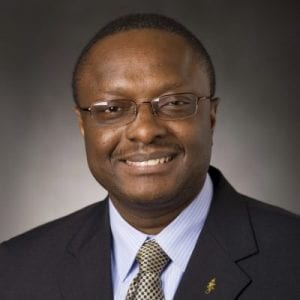
Chimay Anumba
· Dean and ProfessorUniversity of Florida · Historic Preservation
Active 1995–2026
About
Chimay Anumba is a faculty member at the UF College of Design, Construction and Planning. His research focus includes areas related to construction, design, and planning, with particular emphasis on integrating innovative technologies and methodologies into the construction industry. His work involves exploring new approaches to improve construction processes, enhance project management, and develop sustainable building practices. He has contributed to the field through research that advances understanding of construction informatics, project delivery, and the application of digital tools in design and construction. His background includes extensive experience in the construction sector, and he has been involved in academic and practical initiatives aimed at transforming construction practices through technological integration and process optimization.
Research topics
- Computer Science
- Computer Security
- Engineering
- Systems engineering
- Software engineering
- Embedded system
- Engineering management
- Business
- Risk analysis (engineering)
- Process management
Selected publications
Integration of design and construction – a review
2026-02-11
articleThe construction industry has long been recognised as having inherent problems leading to inefficiencies in the services and products it provides. Dependent on collaborative working, the industry has recognised that improved integration is one of the three main drivers for developing a culture of continuous improvement necessary to achieve the improvement targets set in the “Egan Report”. This paper provides a current review of integration within the construction industry. It categories the facets of integration and reviews the drivers for improving integration. It identifies some of the current tools and techniques being used to improve integration and then explores the current barriers acting against them. It concludes that hard process improvement has been successfully developed and implemented. However, it suggests that much further work is required to address the inherent cultural problems which significantly reduce the effectiveness of the many tools and techniques available.
Digital Twin-Based Prototype System for Healthcare Facilities Management
2025-01-28 · 1 citations
book-chapterSenior authorEffective facilities management (FM) is crucial for healthcare facilities to ensure public health and safety. However, the currently adopted FM practices and systems suffer from shortcomings such as inadequate real-time updates, limited 3D visualization, and insufficient virtual systems monitoring. Consequently, the need to address these issues using smarter FM systems such as Digital Twin (DT) technology offering promising solutions requires deliberate discourse. This research focused on identifying key healthcare facility management issues amenable to DT solutions, using a mixed methodology, including literature review, case study, interviews, and prototyping to address the issues. The study developed four scenarios based on insights from the case study and interviews, guiding the development of a DT-based prototype system for healthcare FM. The prototype system integrates DT-enabling technologies such as virtual prototyping/modeling technologies, wireless sensors, data analytic techniques, communication networks, and mobile devices. The DT-based prototype system was used to monitor indoor air quality (IAQ) and visualize data on the 3D model of the healthcare facility. The effectiveness of the prototype system was validated by a focus group and it was concluded that this study provides a foundation for enhancing healthcare FM through the adoption of DT approaches.
A Conceptual Framework for Implementing Digital Twins in Infrastructure Upgrades and Retrofits
CIB Conferences · 2025-06-19 · 1 citations
articleOpen accessThe United Nations (UN) Sustainable Development Goal (SDG) 9 emphasizes the need for sustainable and resilient infrastructure. An important pathway to achieving this goal is to upgrade and retrofit existing infrastructure to reduce carbon emissions, which is a top priority of the Bipartisan Infrastructure Law in the United States. Existing research has recognized that Digital Twins (DTs) are valuable for retrofits. Yet, current efforts are fragmented, focusing on specific types of infrastructure, and do not provide an approach that can be applied to the aggregated infrastructure stock. The variety of infrastructure systems makes focusing on DT-based methods for infrastructure upgrades and retrofits at an aggregate level difficult, as different types of infrastructure will require different approaches. This paper presents an early-stage conceptual framework to address this gap by proposing a generic system of systems approach to DT modeling for infrastructure upgrades and retrofits, employing a systems technology view within the General Systems Theory paradigm and theoretical elaboration of foundational DT components. The proposed framework offers a standardized method that considers the interdependencies of components of various infrastructure systems, towards tracking relevant information through the construction, in-use, and end-of-life phases, as well as evaluating green financing as a crucial component of infrastructure retrofits.
SMART CITY DIGITAL TWIN: A SYSTEM-OF-SYSTEMS APPROACH
CIB Conferences · 2025-06-19 · 2 citations
articleOpen accessThe concept of smart cities has emerged to battle the problems facing cities from rapid urbanization and mismanagement of resources. In order to monitor and control these large-scale environments such as cities, digital twins were proposed. These digital twins represent a large-scale environment virtually and connect it to the physical world. However, complexity arises when studying these cities. A city is a complex system of interconnected systems, or a system-of-systems (SoS), according to definitions by systems engineering. To understand how SoS can be applied to a smart city digital twin, a literature review is first conducted on SoS applications in construction in order to understand how to apply it to the different parts of a smart city. This paper the proposes a unique view on smart city digital twins by applying the system-of-systems engineering approach to view the cities and thereby understand and model them.
2025-12-11
articleSenior authorCorrespondingThis study explores the automation of smart contract generation in construction, leveraging Large Language Models (LLMs) like OpenAI’s ChatGPT. Traditional construction contracts often suffer from delays and disputes, particularly in payment processes. The paper investigates automating the transformation of these traditional contracts into smart contracts, which promise enhanced efficiency and transparency. By conducting an extensive literature review and analyzing various contract types, the study identifies critical elements that are translatable into smart contracts. The experimental phase demonstrates the effective use of the ChatGPT API in extracting necessary contract information for conversion. This approach aims to streamline contract management, reduce disputes, and improve overall project execution. The potential of LLMs in this context is significant, indicating a shift towards more automated, reliable, and transparent contract management in the construction industry.
Generative AI for Predictive Maintenance in Buildings
Lecture notes in civil engineering · 2025-01-01
book-chapterSenior authorFrontiers of Engineering Management · 2025-01-22 · 4 citations
articleOpen accessAbstract Building information modeling (BIM) has become prevalent in construction engineering management. However, the efficiency of traditional file-based BIM exchange between multidisciplinary teams remains low due to the transmission of redundant data from mostly unchanged BIM objects. Additionally, the traceability of changes between BIM files is limited. This paper proposes a traceable semantic differential transaction (tSDT) approach for open BIM exchange, which minimizes data redundancy and enables semantic-level traceability of BIM changes. Furthermore, openBIMdisk implements the tSDT and provides a Blockchain 3.0 virtual disk to support efficient, traceable, and secure BIM exchanges across multiple blockchain services. A pilot study of a modular construction project demonstrated the effectiveness of tSDT and open-BIMdisk. Experimental results indicated that tSDT achieved minimal BIM redundancy for storing and restoring all BIM changes, using a sheer 0.007% of disk space on average. openBIMdisk facilitated BIM version management and object-level semantic traceability with a response time of 5.3 ms. The contributions of this paper are twofold. First, tSDT offers a novel and efficient approach for semantic BIM change traceability. Second, openBIMdisk provides BIM practitioners with a Blockchain 3.0 application featuring intuitive and user-friendly interfaces for BIM exchange.
Key drivers of digital twin maintenance management for healthcare facilities in Nigeria
Engineering Construction & Architectural Management · 2025-09-16 · 1 citations
articleOpen accessSenior authorPurpose The healthcare sector in developing countries needs a more vigorous technological process to support maintenance activities. The ease of adopting the digital twin (DT) technology will depend on stakeholders’ exposure to the advantages. Therefore, this study aims to determine the key drivers of digital twin maintenance management (DTMM) for healthcare facilities in Nigeria. Design/methodology/approach The post-positivist philosophical perspective adopted in this study informed a mixed-method research approach using a Delphi study and a questionnaire survey. In total, 11 digital technology experts domiciled in building maintenance participated in the Delphi study, and 442 maintenance personnel, top management staff and heads of departments in Nigerian hospitals formulated the respondents for the questionnaire survey. Descriptive statistics and confirmatory factor analysis (CFA) using the structural equation modelling technique were used for data analysis. Findings The experts’ responses indicated that the 17 listed variables had a very high impact on determining the DTMM of healthcare facilities in Nigeria. Consequently, the CFA showed that all parameter estimates for the derived ten indicator variables were statistically significant, and the robust fit indexes all met the cut-off index criteria. The measurement model for the DTMM drivers adequately matched the sample data. The foremost drivers are increased reliability of building components, maintenance cost reduction due to prediction before failures and smart management of site activities. Practical implications The study enlightens the authorities and management of healthcare organisations on the benefits of DT technology in maintaining their facilities. It provides the motivation and guidance for decision-making, training of stakeholders and the full implementation of DT technology in the management of hospital facilities. Originality/value The innovativeness and emergence of DT technology, especially within the Nigerian healthcare sector, portend the need to determine the benefits of adopting DT in managing constructed facilities.
Actual construction cost prediction using hypergraph deep learning techniques
Advanced Engineering Informatics · 2025-02-24 · 14 citations
articleCorrespondingRoutledge Handbook of Smart Built Environment
2025-01-28 · 3 citations
bookSenior authorForeword by Faye BowserIntroductionChimay J. Anumba andWeisheng LuChapter 1: Digital twins for smart decision-making Chady Elias, Isabelle Southern, and Raja R.A.
Recent grants
Frequent coauthors
- 121 shared
John Messner
Pennsylvania State University
- 95 shared
Robert Leicht
Pennsylvania State University
- 87 shared
Ralph Kreider
- 81 shared
Craig Dubler
Pennsylvania State University
- 80 shared
Sean Goodman
- 80 shared
Chitwan Saluja
- 80 shared
Colleen Kasprzak
- 80 shared
Nevena Zikic
- Resume-aware match score
- Save to shortlist
- AI-drafted outreach
See your match with Chimay Anumba
PhdFit ranks faculty by your research interests, methods, and publications — grounded in their actual work, not templates.
- Free to start
- No credit card
- 30-second signup